2026 APCSSM
Asia-Pacific Conference on Social Sciences & Management
January 30 to February 1, 2026 in Nagoya, Japan
Venue: Nagoya Convention Hall
〒453-6102 愛知県名古屋市中村区平池町4-60-12 グローバルゲート
(4-60-12 Hiraike-chou, Nakamura-ku, Nagoya, Aichi, 453-6102, Japan)
TEL:052-433-1488 FAX:052-433-1489
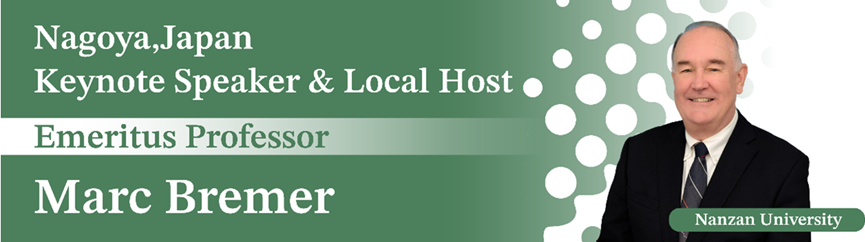
Marc Bremer is an emeritus professor of management at the Faculty of Business Administration of Nanzan University and an adjunct professor at the Institute for the Liberal Arts of Doshisha University. His research concerns financial markets, banking and management. His work has been published in the Journal of Financial and Quantitative Analysis and the Journal of the Japanese and International Economies. Two recent articles are, “Lessons from Mergers and Acquisitions of Regional Banks in Japan: What Does the Stock Market Think?” and “Short Sales Constraints and Stock Returns: How Do the Regulations Fare?”. He finished his Ph.D. at Claremont Graduate School after completing a M.S. degree at the London School of Economics and Political Science. He was a Fulbright lecturer at Nagoya University and NanzanUniversity. He was also a financial controller at the Northrop Corporation. Currently he is writing about the long-term implications of golden shares for American industrial policy.
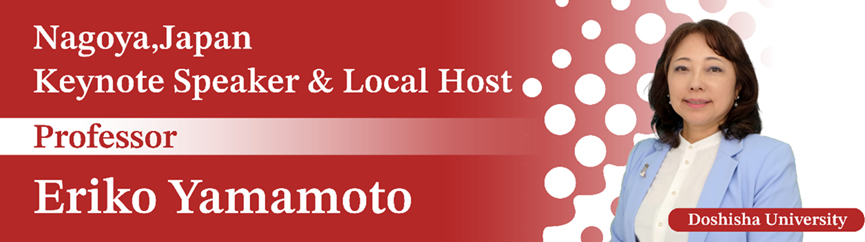
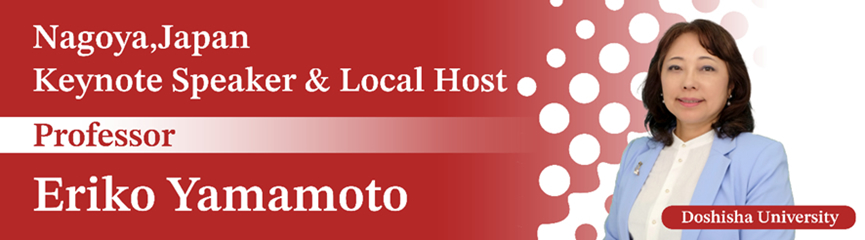
Eriko Yamamoto, Ph.D., is a historian specializing in Japanese American history, ethnicity and Oral History. Currently she is an American Studies Center adjunct researcher and on the Global and Regional Studies adjunct faculty of Doshisha University. Formerly she was a professor of American Studies at Sugiyama Jogakuen University in Nagoya (1989-2003) and a Fulbright Visiting Scholar at UCLA Asian American Studies Center (1998-99). In 2003-4, she was on the Discover Nikkei international project at the Japanese American National Museum to launch a new website on the Japanese diaspora. A native of Ishikawa Prefecture, Yamamoto received her BA in English from Kobe City University of Foreign Studies. While pursuing an MA in American Studies at the Univ. of Tsukuba, she went to Claremont Graduate School on a Sankei Scholarship, receiving an MA in American Studies in 1983 and followed with an East-West Center Grant to further her study on Japanese immigration history at the University of Hawaii at Manoa. Her Ph.D. was awarded in 1988 in American Studies. In her effort to promulgate oral history in Japan, she has co-founded the Japan Oral History Association in 2003. A life member of Oral History Association (U.S.), she is the first Japanese to be elected Council member for the International Oral History Association (2004-6). Her publications include “Miya Sannomiya Kikuchi: A Pioneer Nisei Woman's Life and Identity,” Amerasia Journal (1997), “Cheers for Japanese Athletes: The 1932 Los Angeles Olympics and the Japanese American Community,” Pacific Historical Review (2000), “Oral History in Japan: The Need for Collective Effort and Communication among Practitioners,” Words and Silences (2002). She serves as the president of the East-West Center Chubu Chapter and the vice-president of the Nagoya Fulbright Association. She is also an amateur folk singer who admires Joan Baez and performs in Kyoto/Osaka to promote world peace.
Welcome Message from the Local Hosts
Dear Friends and Colleagues,
Our warmest greetings from Nagoya, Japan!
We are truly excited to be the local hosts for the 2026 International Joint Conferences of APCSSM/ISEPSS/ICEAI/ISCEAS in Nagoya, the heartland of Japan’s manufacturing industry and advanced science, and to have you take part in the international engagements on our site!
Historically Nagoya has played an important role as the birth place and home ground for great samurai leaders who aspired to unify the nation. While aristocratic cultural sophistication may not be visible as in Kyoto, the long tradition of high culture was deeply imbedded. Now combined with modern sophistication as an economic center, Nagoya takes pride in its leading status in advanced industries such as automotive, robotics, machine tool manufacturing, aerospace and ceramics, in which our local companies are known worldwide. As a major academic center in central Japan, Nagoya and its vicinity have dozens of great universities, of which Nagoya University is the most famous. Of the thirteen Japanese Nobel Laureates to this day, six are from Nagoya University, making it the nation’s No. 1 science institution. Some surmise the reason may lie in Nagoya University’s free-spirited atmosphere where junior scientists can contribute their opinions. On the other side, anime, popular culture and figure skating are also major charms of the city.
We landed in Nagoya in 1989 because of Marc’s Fulbright assignment to Nanzan University and Nagoya University, as a married couple. As our sojourn got gradually extended and became more than 30 years, Nagoya has become more than our home. We have witnessed the city’s transformation into a sophisticated international city with a strong industrial backbone.
The Conference venue, the Nagoya Convention Center, is wonderfully convenient. It is next to the main train station and is the hub of many activities including corporate headquarters, major railroads and subway lines and easily accessible from Centrair Airport. Within walking distance are the Noritake Museum and the Toyota Commemorative Museum of Industry and Technology. We sincerely hope you will enjoy your visit to the city, as well as the fruitful sessions and interactions at the conference. We look forward to meeting you and welcoming you to our city!
Sincerely,
Eriko Yamamoto and Marc Bremer
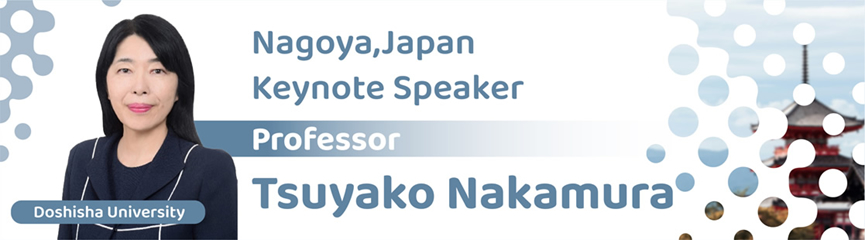
Tsuyako Nakamura is a professor at the Faculty of Global Communications of Doshisha University. Her specialty is women's labor issues in the U.S. and Japan. Currently, she is researching work-life integration and employment policy for women's advancement with Grant-in-Aid for Scientific Research from the Japan Society for the Promotion of Science (JSPS). Her major publications include co-authored books, Work-LifeIntegration (2021), Human Resource Management in the Era of EVP (Employee Value Proposition) (2018), Work-life Balance and Management (2017) and Creating Gender Equal Workplace (2004). She finished her Ph.D. course at Doshisha University after obtaining M.A. at Monterey Institute of International Studies in California as a Rotary International student. She was a Fulbright Visiting Scholar at Stanford University and Harvard University in 2009-2010. She has been active for social leadership programs including TOMODACHI MetLife Women's Leadership Program as the first-year mentor/chaperone (2013), and Kansai Economic Federation's women's empowerment program as coordinator (2014-2023). From June 2021 to August 2024, she served as president of the Japan Academy of Labor Management.
Parenting in the Age of Transformation: Japan's Response to Demographic and Technological Shifts
Japan is undergoing a profound demographic transformation, with a total fertility rate of 1.15 and a rapidly aging population. These shifts have led to labor shortages and fiscal pressures, while the rise of artificial intelligence is reshaping employment, demanding more flexible and human-centered policies. In response, the Japanese government has elevated childcare support as a national priority--recognizing that sustainable work-life integration is essential not only for individual well-being but for long-term social resilience.
The Children and Families Agency (CFA), established in 2023, coordinates childcare policy and promotes inclusive family support. Its initiatives emphasize qualitative improvements enhancingaccess, workforce capacity, and digital integration over mere expansion. Recent reforms to the Child Care and Family Care Leave Act, effective April 2025, introduced the Postpartum Paternity Leave Support Benefit, offering up to 80% wage compensation for fathers within eight weeks of childbirth. With exemptions from social insurance premiums and tax, the effective income replacement approaches 100%. These measures contributed to a record male parental leave uptake rate of 40.5% in FY2024, up from 30.1% the previous year. Large companies are now required to disclose male leave statistics annually, reinforcing accountability and cultural change.
Childcare provision has also expanded. As of April 2025, licensed childcare enrollment reached 2.83 million children, while waiting lists declined to just 1,215. Corporate involvement is diversifying: while some firms operate enterprise-led childcare facilities-6,217 nationwide serving over 110,000 children many others support employees through subsidies, partnerships with local centers, or flexible work arrangements. Notably, 56% of enterprise- led facilities are jointly operated, enhancing regional access and cost efficiency.
Broader government initiatives include increased child allowances, expanded parental leave eligibility, and plans to integrate childbirth costs into public health insurance by 2026. Municipalities and employers continue to invest in childcare infrastructure, supported by managerial training and public awareness campaigns.
In the age of AI, care work remains irreplaceable. While technology enables remote work and task automation, it cannot replicate empathy, emotional labor, or the parent-child bond. Japan's approach highlights care as a strategic investment and positions work-life integration not as a personal compromise, but as a societal imperative for inclusive growth and economic sustainability. This presentation argues that childcare support is not merely a demographic countermeasure-it is a blueprint for a more integrated, adaptable, and compassionate society.
Oral History and the Ainu Message to the World:
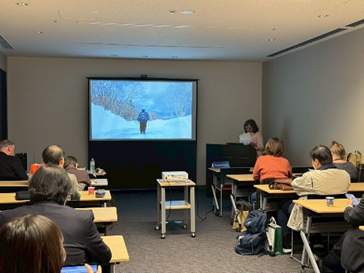
Through Shizue Ukaji’s Documentary, Daichi-yo!
Shizue Ukaji is a 92-year-old Ainu woman who is speaking up to express her concerns for world peace and the environment, offering her Ainu heritages and wisdom as her last testament. Her message to younger generations of Ainu and non-Ainu herald regained ethnic pride that shines out especially in her 2023 documentary film, Daichi-yo, produced by Fujiwara Shoten and directed by Kin Taii. The film is a rare product of oral history in Japan, depicting a minority group from their own perspective with dignity and respect for their culture. The film’s successful use of oral history interviews represents a case of “shared authority”: Ukaji’s oral expressiveness of her indigenous heritage, intermingled with Fujiwara’s social consciousness as an academic publisher and Kin’s adherence to accurately represent Ukaji’s narratives and her world. Additional factors in the success are her advanced age and the new law that respects Ainu culture, as well as interactions with other indigenous peoples in the world. The film is a highly educational contribution as it shows Japan’s multicultural history arising from the Meiji government’s annexation of Hokkaido and yet hidden because of its assimilation policy and oppression toward the Ainu. The analysis of Ukaji’s documentary film and her messages show how one minority woman’s memories and thoughts can be recorded, preserved and spread through Oral History interviews in an audiovisual format. As Japan and the world are becoming more inward-looking and hostile toward people of different origin or culture in recent years, the film can provide a precious perspective and serve as an educational tool, while showing researchers how to center the minority’s perspective and identity when recording their history.