13th ICEAI in Osaka, Japan, January 22-24, 2027
International Congress on Engineering and Information
Special Session: Intelligent Systems for Sustainable Engineering
We are pleased to invite you to the 13th International Congress on Engineering and Information (ICEAI 2027), taking place in Osaka, Japan, from January 22 to January 24, 2027.
ICEAI 2027 brings together scholars, researchers, and professionals to share insights, explore emerging trends, and discuss developments across engineering and information disciplines. The congress highlights innovative research and practical approaches that are shaping the future of technology and industry.
As global priorities continue to shift toward sustainability and responsible innovation, increasing attention has been given to how engineering and information systems can address environmental and societal challenges.
This conference also includes multiple sessions related to the academic fields of engineering and information. We encourage researchers from both industry and academia who have expertise in following listed (but not limited) areas to submit their contributions.
|
Earth Sciences | Civil Engineering | Mechanical Engineering |
Electrical Engineering | Information Sciences | Chemical and Bio Engineering |
Industrial Engineering | Material Science & Engineering | Environmental Sciences |
In this context, ICEAI 2027 features a special session focused on the role of intelligent systems in advancing sustainable engineering.
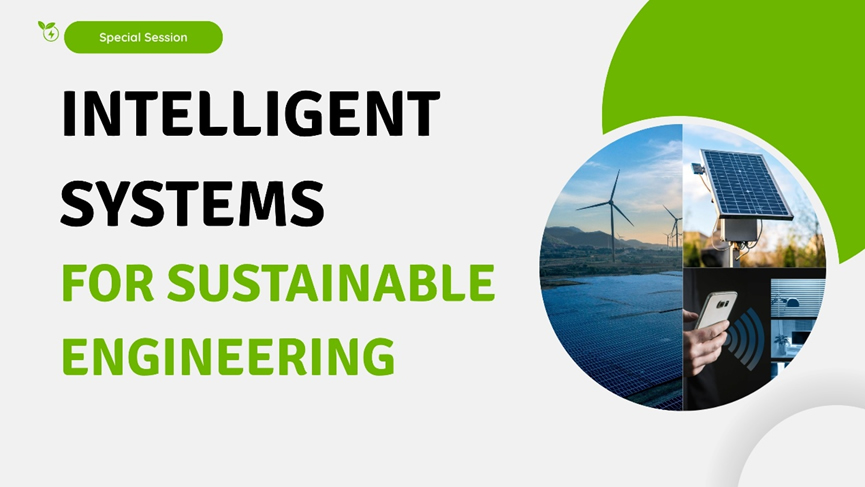
Special Session: Intelligent Systems for Sustainable Engineering
As sustainability and resource challenges become more pressing worldwide, engineering solutions are increasingly expected to be both efficient and environmentally responsible.
Recent advances in artificial intelligence, data analytics, and smart technologies offer new ways to enhance system performance while supporting sustainable outcomes.
This special session focuses on how intelligent systems can be applied to address these challenges across engineering and information fields.
It encourages discussion on bridging technological innovation with real-world implementation, with the goal of developing more adaptive, efficient, and sustainable systems.
Participants will have the opportunity to share research, exchange perspectives, and explore emerging directions in this rapidly evolving area.
We invite researchers and professionals to contribute and take part in advancing intelligent and sustainable engineering solutions.
We welcome both theoretical and applied research, as well as case studies and practical implementations.
Topics of interest include, but are not limited to:
AI and Data-Driven Approaches in Sustainable Engineering
| Machine learning and optimization for engineering systems |
| Data analytics for resource efficiency and sustainability |
| Intelligent decision-support systems |
Smart Infrastructure and Sustainable Systems
| Smart cities and intelligent infrastructure |
| Energy-efficient and green engineering systems |
| Sustainable transportation and urban development |
Environmental Monitoring and Resource Management
| IoT and sensor networks for environmental monitoring |
| Water, energy, and resource management systems |
| Climate and environmental data analysis |
Industrial Applications and Sustainable Manufacturing
| Intelligent manufacturing and automation |
| Sustainable production and supply chain optimization |
| Low-carbon and energy-efficient industrial systems |
Human–AI Collaboration and Sustainable Behavior
| Human–AI interaction in engineering systems |
| Behavioral aspects of sustainability and decision-making |
| Adoption of intelligent technologies in real-world contexts |
Policy, Governance, and Sustainability Strategy
| Sustainability policies and regulatory frameworks |
| Corporate sustainability and ESG practices |
| Governance of intelligent and sustainable systems |
AI, Digital Twins, and Emerging Technologies
| Digital twins and smart simulation systems |
| AI-driven engineering design and innovation |
| Integration of emerging technologies for sustainability |