2026 HKICEPS
10th International Conference on Education, Psychology, and Society
June 19-21, 2026 Hokkaido, Japan
Venue: Premier Hotel -TSUBAKI-Sapporo

Biography:
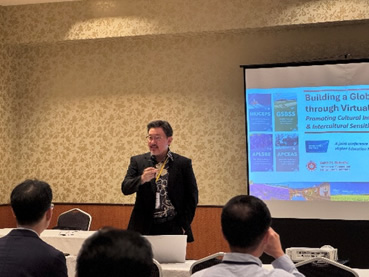
Keith H. Sakuda is a professor of management and international relations at the University of Hawai‘i – West O‘ahu. His research interests are international virtual exchange, cross-cultural management, and social entrepreneurship. He has also held faculty appointments at Chongqing Technology & Business University (China) and Kansai Gaidai University (Japan) and served as an external reviewer for Hong Kong Baptist University’s College of International Education.
His consulting experiences include sustainable agricultural projects in Hawai'i, Tahiti, China, the U.S., and Japan. He co-founded an award-winning social enterprise which sought to promote food sovereignty in the Pacific Islands through aquaponics and coordinated distributed agriculture.The company was featured in international media, including Fast Company, The Guadian, and National Geographic, and he was invited to speak about it at Harvard University’s Social Entrepreneurship Conference and Fish 2.0 at Stanford University.
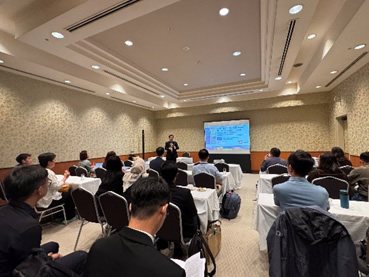
Building a Global Classroom through Virtual Exchange to Promote Cultural Intelligence and Intercultural Sensitivity
International study abroad is a powerful learning experience to help students develop 21st century skills and intercultural competencies, but economic, cultural, and political challenges may prevent students from traveling. Virtual exchange (COIL) is often proposed as a more accessible alternative to studying abroad, but many question whether it can truly promote intercultural learning without providing sustained face-to-face contact.
This session will discuss the development of an award-winning virtual exchange partnership known as international fully integrated virtual exchange (IFIVE). Initially designed as an online pre-study abroad class, IFIVE has evolved to become a semester-long interactive course with an embedded cultural intelligence (CQ) lab. Highlights from the program’s Best of Regions presentation at the Accreditation Council of Business Schools and Programs (ACBSP) Conference will be combined with content from the World Congress on Education (best paper in the category of inclusion) to introduce the IFIVE framework, and data from course evaluations and pre/post assessments for CQ and intercultural sensitivity will be used to demonstrate its effectiveness in promoting intercultural learning. The session will also showcase different distance learning technologies, “flipped” classroom pedagogies, and interactive activities.
In recognition of the unique student demographics in the conference’s host country (Japan), the session will also include a discussion of IFIVE’s “bonus benefit” of introducing non-traditional students to Japanese classrooms. These students, which include working professionals, single parents, and special needs students, create a diverse learning environment rarely found in the country.
It is hoped that this session will encourage attendees to pursue their own virtual exchange programs to promote intercultural learning. It is the sincere belief of the presenter that virtual exchange combined with an emphasis on CQ or intercultural sensitivity can create an inclusive and accessible global classroom for all students.

Introduction:
Dr. Younbo Jung is Associate Professor and Associate Chair - Academic at the Wee Kim Wee School of Communication and Information, Nanyang Technological University, Singapore. Dr. Jung earned his Ph.D. at the Annenberg School for Communication and Journalism at the University of Southern California. In teaching, Dr. Jung received four teaching-related awards at NTU, including Nanyang Education Award (University) – Bronze in 2014. He is the inaugural Fellow of Teaching Excellence Academy since 2014. In research, his interests include socio-psychological effects of interactive media such as video games, virtual reality systems, human-robot interaction, and their applications in education and medical aids. Dr. Jung supports interdisciplinary research and has successfully collaborated on many research projects with scholars in computer science, electrical engineering, physical therapy, and social work.
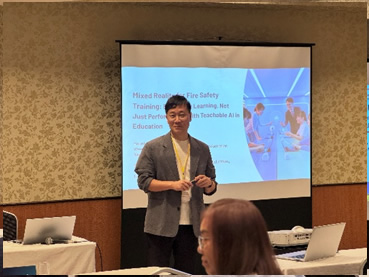
Mixed Reality for Fire Safety Training
Mixed Reality (MR) technologies are increasingly used to simulate high-risk, real-world situations that are difficult or unsafe to reproduce in traditional training settings. Drawing on evidence from MR-based fire safety training, this keynote explores how different instructional approaches and the design of virtual agents shape learning experiences in immersive environments. I compare trial-and-error learning with direct instruction and examine how the presence of a virtual child agent alters learners’ cognitive and emotional responses during crisis simulations. The findings demonstrate that trial-and-error learning can foster deeper reflection and more robust learning outcomes, even as it heightens stress, whereas direct instruction becomes more effective and preferred when virtual agents are embedded in the simulation. Taken together, these results underscore the need to align pedagogical strategies with the affordances of immersive technologies and the social cues introduced by virtual agents. The keynote concludes by discussing broader design principles for MR-based training and education, with implications for safety training, professional development, and future human–AI interaction in immersive learning environments